How Do Doctors to Genetic Testing on Babies in the Womb?
What is genetic testing? It refers to medical testing to identify changes within chromosomes, genes or proteins encoded by these genes. The purpose is to ostend or exclude a genetic disorder, or to quantify the risk that an individual carries, will laissez passer on, or will develop such a disorder.
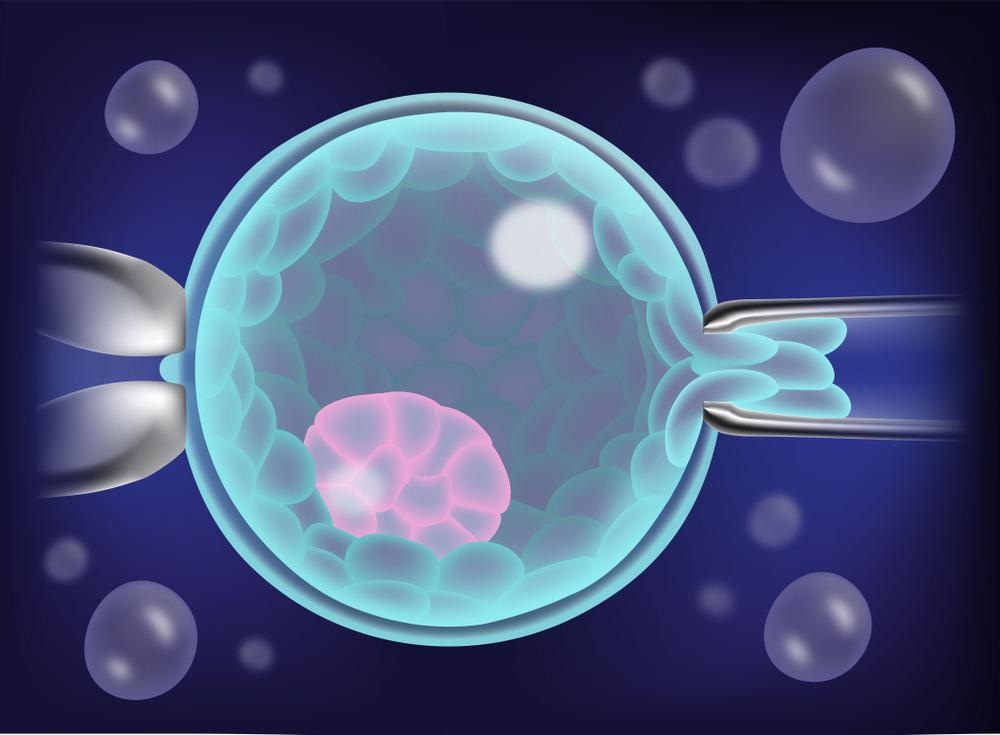
Preimplantation genetic screening. Paradigm Credit: DAntes Design/Shutterstock.com
Genetic testing inside pregnancy is usually carried out on a routine basis to exclude a few atmospheric condition such as cystic fibrosis, Fragile Ten syndrome, sickle cell illness, Tay-Sachs disease and spinal muscular atrophy. Expanded genetic carrier modules are at present becoming available that can find >400 new diseases.
The indications for genetic counseling in pregnancy may include:
- Family history of genetic disease or chromosomal anomaly; abnormal development; birth defect;
- Abnormalities during newborn screening, or whatever developmental problem at nascency or during childhood, for the children of any family fellow member
- Prior history of preterm birth, two or more than miscarriages, stillbirth, or sudden baby death syndrome (SIDS), or child with whatever congenital anomaly or genetic illness
- History of infertility
- Abnormal images on the multiple marker screen or ultrasound scanning in early pregnancy
- Mothers will be 35 years or older at the time of delivery
- Exposure to agents that may affect the genes, such every bit medications or environmental toxins
- Consanguinity of the parents
- Certain ethnic backgrounds associated with specific genetic defects
The presence of whatever of these indications should atomic number 82 to counseling on the genetic risk, based on which a decision to comport out genetic testing is made to place the presence of such atmospheric condition.
Stages of genetic testing
Preimplantation genetic diagnosis (PGD)
PGD comprises the testing of cells from a very early embryo, obtained through in vitro fertilization (IVF), grown to the stage of uterine implantation in an external medium. These cells are subjected to genetic testing, following which the embryo is discarded or implanted.
Prenatal Diagnosis
This refers to the performance of genetic tests on a fetus when there is a adventure of having a baby with genetically determined mental retardation or physical deterioration. It is extremely controversial because the but selection to deal with the identified genetic problems in the offspring is by aborting the pregnancy.
In the case of some anomalies such every bit Down's syndrome, the fetus is aborted on the ground of a feared mental deficit, which is not e'er the case. Also vexed is the right to arrest a fetus simply because the sexual practice is wrong.
Blood-based testing
This consists of measuring certain hormones (alpha-fetoprotein, homo chorionic gonadotropin (hCG), unconjugated estriol, and inhibin) in the mother's claret – the triple or quad screen, alias the multiple marker screen, allonym the AFP plus) – coupled with an ultrasound browse to evaluate the thickness of the pare on the back of the babe's neck – the nuchal translucency test. Increased fluid accumulation or a cystic appearance could signal trisomy 21, or congenital heart affliction. It will option up >ninety% of Down syndrome cases, and other chromosomal anomalies.
Jail cell-costless DNA (cfDNA) screening or non-invasive prenatal testing (NIPT) targets the minute amounts of fetal Dna fragments circulating in the maternal blood, to place patients at high hazard for such abnormalities, assuming that the maternal and fetal genomes will be identical. This allows more sensitive detection of most of the trisomies normally encountered and a lower false-positive rate.
Fetal testing
This refers to procedures like amniocentesis and CVS, where a needle is used to draw out amniotic fluid or modest amounts of placental tissue, respectively, under ultrasound guidance, for genetic testing. Percutaneous Umbilical Blood Sampling (PUBS, Cordocentesis, Fetal Blood Sampling) is another method used at 20 weeks of pregnancy or later, for special indications but.
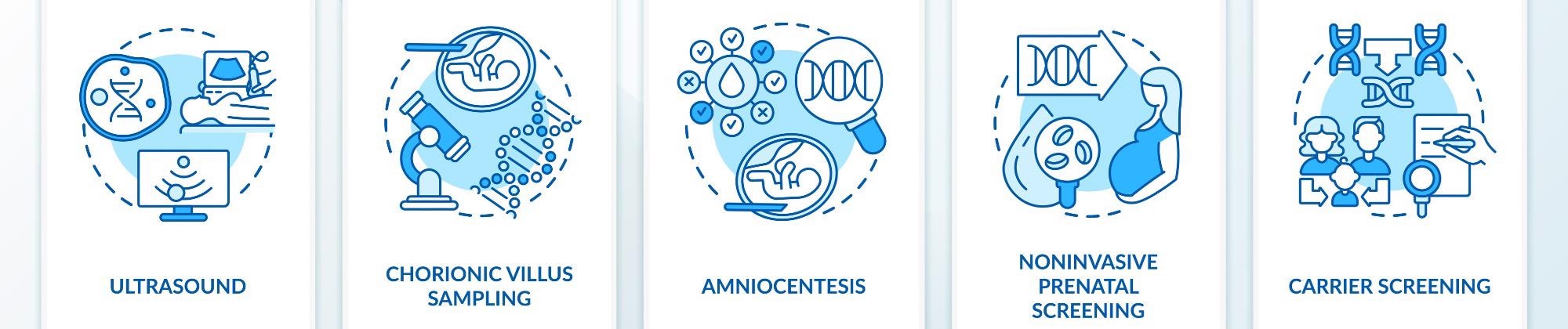
Types of genetic screening. Image Credit: bsd studio/Shuttestock.com
Carrier testing
Sometimes, the counseling helps parents understand their chances of transmitting an abnormal factor to the baby.
If the gene is one of a pair of which both are required for normal function, both parents must take and pass on a defective re-create if the infant is to get the affliction. If only one parent has one lacking copy, he or she may laissez passer it on to some of the babies, but has no symptoms. Such an individual is a carrier, and the baby too becomes a carrier.
If two carriers have a babe, in 25% of cases the offspring will receive 1 copy of the defective gene from each parent, and volition develop the disease. This is a loftier run a risk for disease.
Some examples are sickle cell affliction in several Black communities and many tribal communities in India, and the Tay-Sachs disease in Ashkenazi Jews. Carrier screening is suggested to cheque for the presence of such a cistron in potential parents if they then desire.
At present, universal genetic testing is recommended to rule out cystic fibrosis and spinal muscular atrophy, while all women should exist checked for the presence of hemoglobinopathies.
The problems
Genetic testing is controversial among many mothers to be, who do not wish to decline their babies on whatever pretext.
Secondly, screening tests based on blood markers are not 100% perfect, and the resulting risk is a potent source of stress on the parents. Even if the babe does inherit defective genes, it does not follow that symptoms will arise or that the child will develop astringent disease, the results practise not convey the risk of progressive affliction.
Thirdly, genetic tests may bring to light existing or potential conditions that were previously unknown, uncovering unwelcome knowledge about the potential for each parent and their families to develop certain conditions, but without the possibility of avoiding or averting them. This is surely a source of great stress.
There is a further issue in that the family unit history revealed by these tests would typically exist confidential, simply is unselectively shared by the individual existence tested, leading to a alienation of medical confidentiality and personal privacy.
Conversely, if genes that could affect other family members directly or indirectly are discovered, would it not be the right of the physician or examination recipient to inform those at risk? These are perplexing questions without clear answers.
At that place is also a high possibility that a genetic test showing a problem with the fetus may be used to discriminate confronting the parents or the fetus, or both.
The question of health equity in genetic testing besides arises. Since information technology will be mostly the rich who have admission to genetic testing, the percent of babies with genetic anomalies may become skewed towards lower socioeconomic backgrounds. This is already the example, co-ordinate to some experts.
Each test likewise has its risks, such as amniocentesis and chorionic villous sampling, that can cause pregnancy loss in a small but significant number of cases.
Toll-effectiveness may also be in question, equally, according to one study, the costs of universal screening for cystic fibrosis in order to avoid the birth of one affected baby are many times higher than the costs of managing that one individual medically over a lifetime.
And finally, eugenics and social engineering risks may eventually win the day. Eugenics refers to "the do of manipulating the genes of offspring through either breeding or genetic alteration."
According to Leon Kass, "To be sure, my genetic vices are, as far as I know them, rather modest, taken individually -myopia, asthma and other allergies, bilateral forefoot adduction, bowleggedness and pessimism, plus some four to eight equally all the same undiagnosed recessive lethal genes in the heterozygous condition-merely taken together, if diagnosable prenatally, I might never take made it."
About deaths today are even so not due to genetic factors, just rather occur in so-called normal healthy people. By pursuing genetic testing in pregnancy, volition we head towards a society of 'perfect' offspring, and conversely, one which has nix tolerance for those not 'perfect'? Is this even achievable, and if and so, desirable? It would probably be all-time to conclude that while technology advances, intensive efforts must be taken to avoid the unfair and discriminatory utilize of such engineering science.
References
- What is Genetic Testing? (2021). Available at: https://medlineplus.gov/genetics/understanding/testing/genetictesting/. Accessed on Dec 15, 2021.
- Family Health History Planning for Pregnancy. (2020). Available at: https://world wide web.cdc.gov/genomics/famhistory/famhist_plan_pregnancy.htm. Accessed on December fifteen, 2021.
- Sauder, K. J. The Ethics of Genetic Testing. Available at: https://www.goshen.edu/bio/Biol410/Biol410SrSemPapers/Sauder.html. Accessed on December 15, 2021.
- Friesen, T. (1997). The Genetic Testing Controversy. Bachelor at: https://www.ndsu.edu/pubweb/~mcclean/plsc431/students/friesen.htm. Accessed on December 15, 2021.
- What is Prenatal Screening? Available at: https://www.prenatalscreeningontario.ca/en/pso/about-prenatal-screening/about-prenatal-screening.aspx. Accessed on December 16, 2021.
Further Reading
- All Genetic Disorder Content
- What are Genetic Disorders?
- Genetic Disorder Comorbidities
- Multifactorial And Polygenic (Circuitous) Genetic Disorder
- Unmarried Gene Genetic Disorder
lewisstonclused1959.blogspot.com
Source: https://www.news-medical.net/health/Genetic-Testing-Within-Pregnancy.aspx
0 Response to "How Do Doctors to Genetic Testing on Babies in the Womb?"
Post a Comment